Project Overview
A grand challenge in science today is to develop a scientific understanding of the properties of high-temperature plasmas and apply that knowledge to support the future development of fusion energy. Harnessing fusion would provide a virtually limitless, environmentally friendly power source for the world. The Pegasus Toroidal Experiment conducts research that is part of a worldwide effort to enhance our understanding of plasma behavior and magnetic confinement.
What is plasma?
Plasma is the fourth state of matter, accompanying the more traditional solids, liquids, and gases. It consists of free electrons and ions and can be thought of as an electrically charged gaseous state. Most matter in the universe is in the plasma state.
Each state of matter is associated with characteristic temperatures, which also measure the matter’s internal atomic behavior. When a solid is heated, it melts and becomes liquid. Further temperature increases cause the liquid to evaporate and become a gas. If a gas is heated enough, the atoms ionize and become a plasma. Melting, evaporation, and ionization are all phase transitions corresponding to the breaking of atomic lattice structures, intra-atomic attractive forces, and nucleus-electron bonds, respectively.
Unlike neutral gases, plasmas have electric and magnetic properties because they are ionized. This enables plasmas to be manipulated via applied electric and magnetic fields.
What is fusion energy?
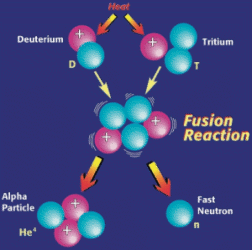
Fusion is a nuclear process that involves combining light atomic nuclei to form heavier nuclei. When a heavier nucleus forms, it releases large amounts of energy. In comparison, nuclear fission (used in today’s nuclear power plants) generates energy by splitting heavy nuclei apart into lighter products. Fusion is a natural process. In fact, fusion is the main source of power in the Sun and other stars in the universe.
Unlike fission, which can occur at room temperature, fusion reactions require extremely high temperatures. At these temperatures (hundreds of millions of degrees C), the fuel atoms are so excited that they are in the plasma state. Because of this extreme thermal excitation, fuel nuclei can overcome their mutual electric repulsion and undergo fusion. For this reason, the process is thermonuclear.
Why pursue fusion energy?
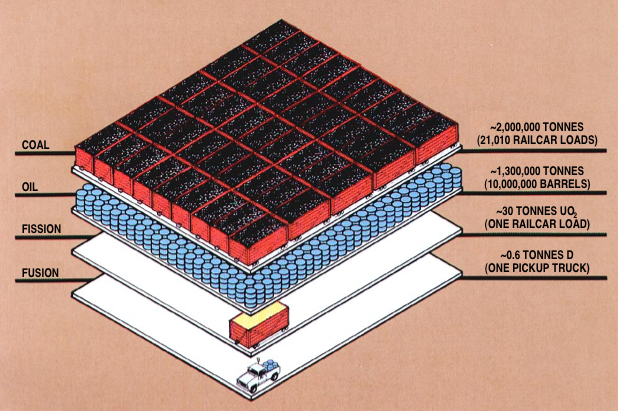
Fusion energy has attractive advantages in comparison to today’s energy sources:
- Abundant fuel available to all nations: The requisite fuel materials for a fusion reactor are deuterium and lithium, which occur naturally in water and in the earth, respectively. The world’s supply of fusion fuels would allow fusion plants to operate for hundreds of millions of years.
- High fuel efficiency: Fusion reactions have very high energy density per unit of fuel. This means that dramatically less fuel is required to generate the same amount of electrical power through other means.
- Environmentally friendly: Fusion reactions do not create harmful greenhouse gases. Although it is a nuclear process, it produces very little radioactive byproducts. There are no nuclear wastes to dispose of — only helium gas.
- Passive safety: A fusion reactor is inherently passively safe. They cannot blow up or melt down as a result of an accident. Additionally, there is a low risk of nuclear material proliferation.
- Reliability: Fusion is not reliant on daily, seasonal, or regional weather variations
Overall, fusion is complementary to other energy sources, and should be considered a major element of a broad portfolio of environmentally attractive energy sources.
What is Pegasus?
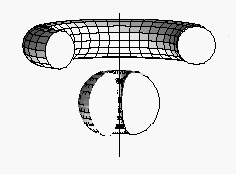
The Pegasus Toroidal Experiment is an extremely low-aspect-ratio spherical torus device at the University of Wisconsin–Madison. We use magnetic fields to create a donut-shaped trap in which we create plasmas for study. (A magnetic trap is required because the extreme temperatures of a plasma will melt any physical container, destroying the plasma in the process.)
Historically, researchers have conducted extensive research on tokamaks, devices that build magnetic traps in the shape of a torus (donut) with a large central hole. Reducing the central hole size leads to the spherical torus (ST) geometry. Theory predicts that the ST can sustain a much higher ratio of plasma pressure to applied magnetic pressure (β) when compared to the traditional tokamak. The stability properties of these high-relative-pressure plasmas are relevant to our basic understanding of plasma behavior. In addition, the compact nature of the ST provides a relatively low-cost path to studying advanced fusion concepts.
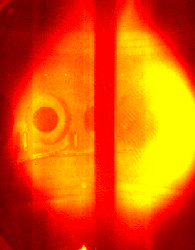
Pegasus is part of a worldwide effort to explore the ST as a plasma confinement concept and study unique plasma effects produced in the ST magnetic trap. The Pegasus research team comprises a small number of staff scientists, graduate students, and undergraduates. Students have been actively involved in Pegasus’s design, construction, and operation since its inception.