About
Advancing fusion energy requires scientific discovery and new approaches to plasma control
Pegasus-III explores the unique capabilities of an extremely low-aspect-ratio spherical tokamak (ST) to address some of the most important challenges in fusion energy research. As a university-based experiment, Pegasus provides a flexible platform for world-relevant studies of plasma behavior and innovative approaches to fusion system design. Our current mission is to compare, contrast, and develop solenoid-free startup and sustainment techniques that could help shape the next generation of fusion energy systems.
A multidisciplinary team of faculty, scientists, engineers, graduate students, and undergraduate students powers research at Pegasus. Since the program’s inception, students have played a central role in designing, building, and operating the facility, gaining hands-on experience while contributing to advances in fusion science.
A viable fusion energy future depends on controlling plasma
Fusion has the potential to provide a virtually limitless source of carbon-free energy by harnessing the same process that powers the sun and stars. Making that future possible requires a deeper understanding of high-temperature plasmas and the technologies needed to control them safely and efficiently.
The Pegasus Toroidal Experiment contributes to a worldwide effort to improve our understanding of plasma behavior and magnetic confinement. By exploring new approaches to plasma startup, heating, sustainment, and control, Pegasus helps address key scientific and engineering questions on the path toward practical fusion energy.
Why study a spherical tokamak?
Some of the most exciting opportunities in fusion research emerge when researchers challenge conventional assumptions.
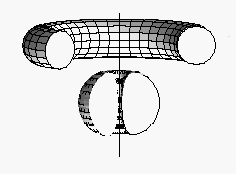
Pegasus is an extremely low-aspect-ratio spherical tokamak (A < 2), a compact tokamak design that offers unique plasma physics advantages. Using magnetic fields, the Pegasus device creates a donut-shaped confinement region that allows researchers to study plasma without it touching and damaging the surrounding vessel walls.
Compared with conventional tokamaks, spherical tokamaks can sustain significantly higher ratios of plasma pressure to magnetic pressure. This operating space provides valuable insight into fundamental plasma behavior while offering a potentially lower-cost pathway for exploring advanced fusion concepts. Pegasus is part of a global effort to understand how spherical tokamaks can expand the possibilities for magnetic fusion energy.
A platform for plasma research since 1992
Medusa (1994-1999)
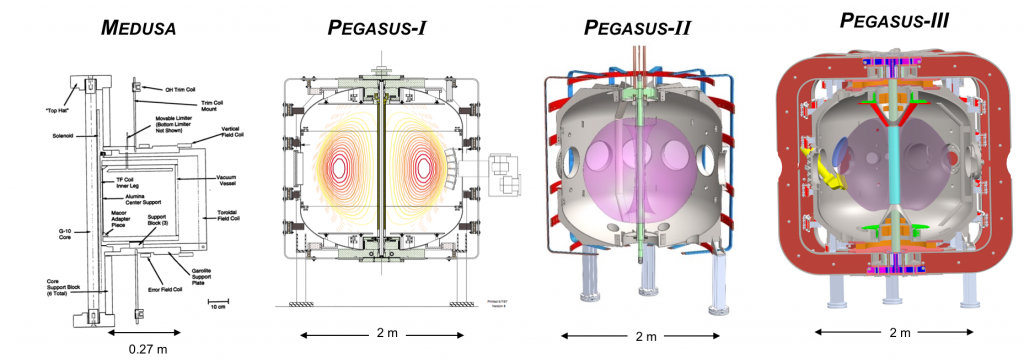
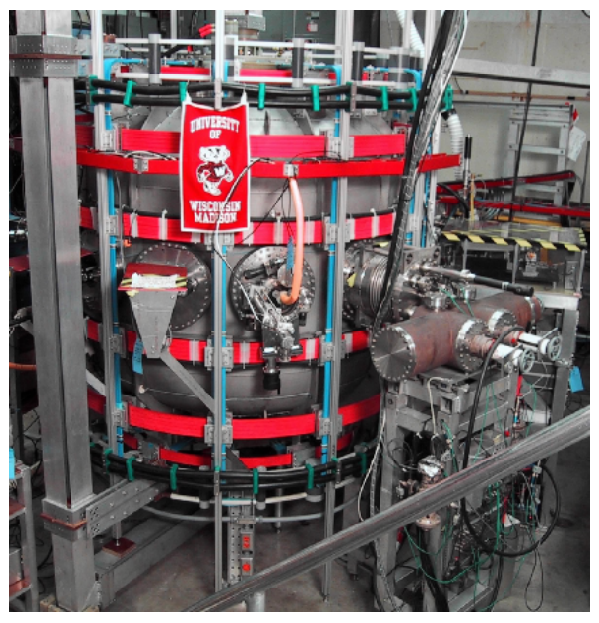
The Madison EDUcational Small Aspect-ratio (MEDUSA) tokamak served as the foundation for the Pegasus program. Originally conceived as an undergraduate project in 1992, MEDUSA provided an important testbed for studying spherical tokamak plasmas and investigating plasma startup physics during Pegasus development. Research on MEDUSA improved understanding of plasma current penetration, magnetic flux consumption, and internal reconnection events, establishing key scientific foundations for future work.
Pegasus Phase I (1998-2002)
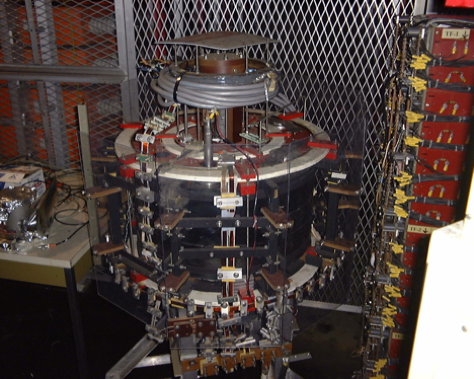
The first Pegasus facility was designed to explore plasma behavior as the aspect ratio approached unity, pushing into a unique operating regime rarely accessed by conventional tokamaks. Research during this phase demonstrated important characteristics of extremely low aspect ratio plasmas, including high plasma pressure, strong confinement, significant paramagnetism, and new insights into plasma stability limits. These studies established Pegasus as an internationally recognized platform for low-aspect-ratio fusion research.
Pegasus Phase II (2003–2019)
Phase II expanded Pegasus with new technologies and advanced control capabilities to improve plasma performance and enable non-solenoidal startup techniques. Major upgrades included flexible magnetic field control systems, Local Helicity Injection (LHI), enhanced magnetic coil systems, and new toroidal field technologies.
These capabilities opened access to new operating regimes and led to significant scientific achievements, including studies of extreme plasma stability limits, record-setting plasma pressure levels, advances in understanding edge-localized modes (ELMs), and important validation of theoretical predictions for low-aspect-ratio plasmas. Pegasus-II also became a leading platform for developing and testing helicity injection as a viable pathway for plasma startup and sustainment.
Pegasus Phase III (2020–Present)
Pegasus-III represents the next chapter in the program’s evolution.
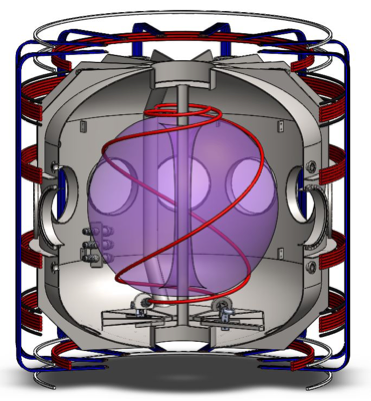
Designed as a dedicated U.S. platform for studying solenoid-free plasma startup, Pegasus-III enables researchers to compare, combine, and optimize multiple startup and sustainment approaches within a single facility. These include Local Helicity Injection (LHI), Coaxial Helicity Injection (CHI), radiofrequency heating and current drive, external magnetic field induction, and neutral beam injection.
The facility features a solenoid-free central column, higher toroidal magnetic fields, new power systems, active divertor coils, next-generation helicity injection technologies, expanded diagnostics, and enhanced radiofrequency capabilities. Together, these investments enable researchers to investigate critical questions in plasma confinement, reconnection physics, current drive, transport, stability, and technology development.
By advancing the scientific understanding needed for efficient plasma startup and control, Pegasus-III contributes to the development of future fusion systems, including the capability to support plasma startup goals on NSTX-U and other next-generation facilities. The project brings together collaborators from Oak Ridge National Laboratory, Princeton Plasma Physics Laboratory, and the University of Washington to accelerate fusion innovation.