Pegasus-III Program
A major upgrade is underway for Pegasus Phase III (Pegasus-III). The new facility will provide a dedicated U.S. platform that will compare, contrast, and combine different concepts for solenoid-free startup.
This approach will enable a more integrated study of leading startup and sustainment techniques, including local helicity injection (LHI), transient and sustained coaxial helicity injection (CHI), radiofrequency heating and current drive, external magnetic field induction, and neutral beam injection (future).
The facility aims to develop a validated concept for 1 MA plasma startup on the U.S. flagship facility NSTX-U and beyond. Construction of Pegasus-III is underway, and the facility will be operational in 2020.
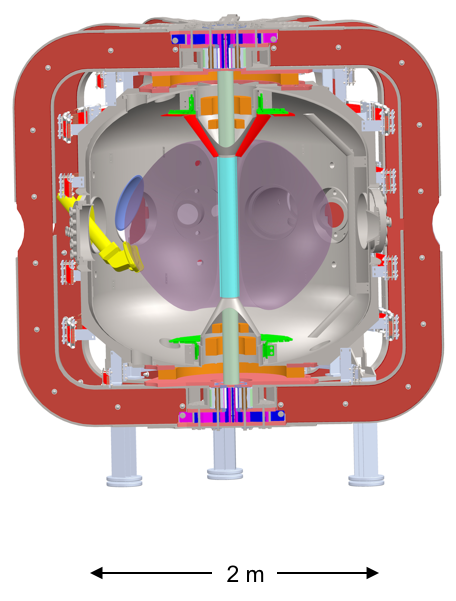
Updated features and research
Pegasus-III will feature many facility enhancements that will allow for the study of several areas of exciting physics and engineering research. New facility features include a solenoid-free central column, a stronger high-toroidal-field assembly, new power systems, active divertor coils, next-generation LHI, coaxial helicity injection (CHI), RF startup and assist, and expanded diagnostics.
Projecting LHI to larger facilities requires tests at increasing toroidal field. Pegasus-III will enable investigation of LHI at higher field levels, allowing testing of key physics issues such as core confinement, reconnection and current drive, stochastic edge transport, and current stream stability. Along with these physics developments is the advancement of LHI technology, including the installation and testing of a non-circular injector concept. Increased toroidal field also enables comparative studies of CHI. This includes both improved technology development and additional physics studies. This will involve improved CHI technology development, including a new electrode configuration, as well as exploration of CHI physics at higher toroidal field.
Pegasus-III will also explore RF heating and current drive capabilities. The initial focus will be on EBW synergies with helicity injection, namely improved startup via electron heating and EBW current drive as a current-sustainment mechanism after helicity-injection startup.